
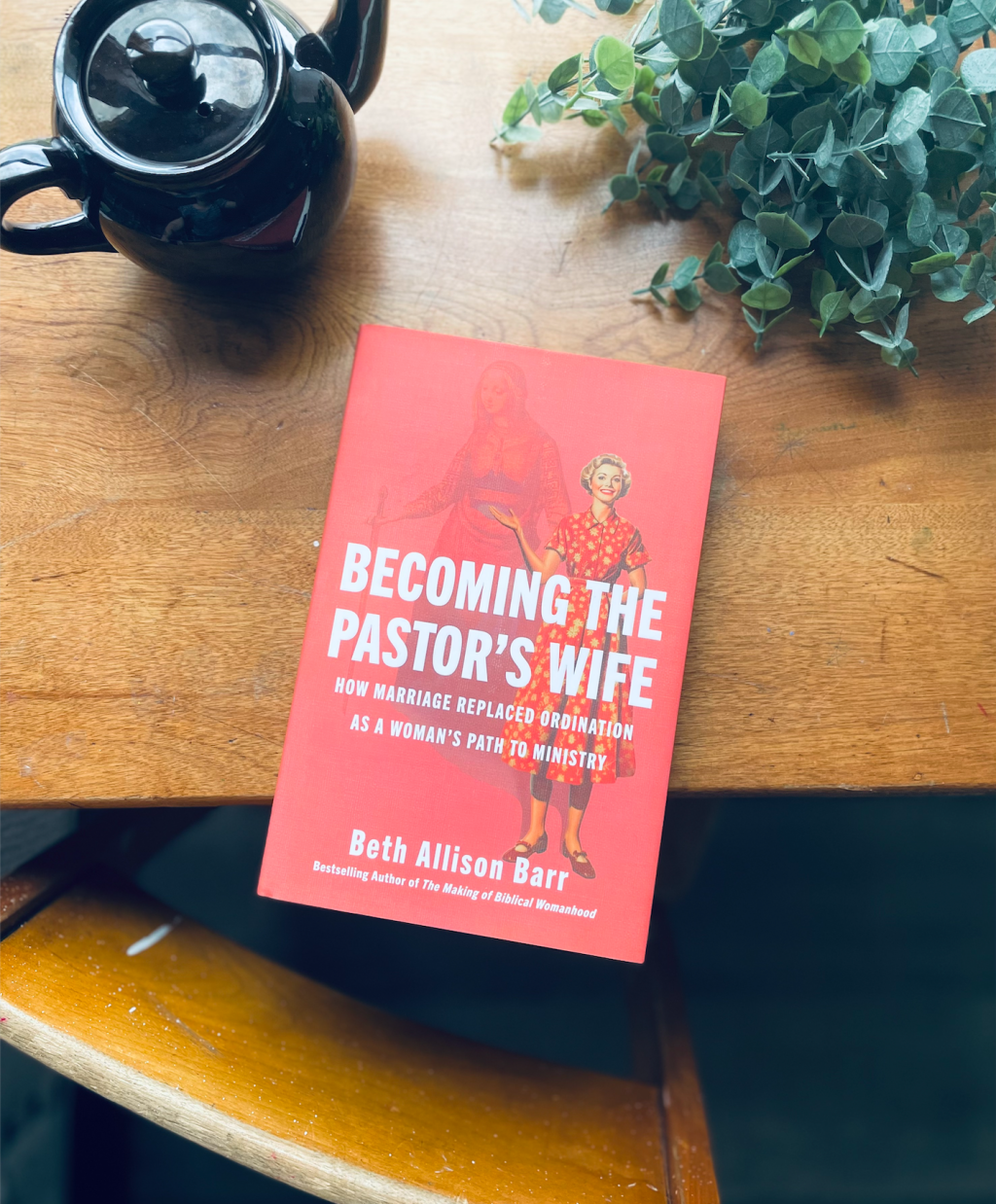

I read Becoming the Pastor’s Wife last month (which has since become a New York Times Bestseller), but haven’t had the time to gather all my thoughts about this book. Because I’m short on time, I thought I’d at least throw together a brief review, followed by some notes I took while reading the book.
I wanted to read this book as I grew up as a pastor’s kid in the SBC denomination, and spent ten years of my adult life as a women in vocational ministry amongst complementarians. The author is also from my area of Texas–only 45 minutes away.
My brief review of Becoming the Pastor’s Wife.
Beth Allison Barr, a professor of history at Baylor University and wife to a Southern Baptist pastor, writes Becoming the Pastor’s Wife: How Marriage Replaced Ordination as a Woman’s Path to Ministry to address misguided expectations that Baptist (and other Protestant) Christians often place on pastor’s wives (or women in general), but also to argue for female ordination and that complementarianism is harmful for women. While I agree with some of Barr’s concerns for Baptist women (not separating the identity of the wife from the husband, assuming a pastor’s wife wants to volunteer in childcare, etc.), because she uses this book to argue for the ordination of female pastors and is very biased against complementarianism, I am not able to rally with her to see these concerns addressed. It is unfortunate, as Barr is a very passionate writer and seems to want to see women within the Southern Baptist world flourish in gospel-filled ministry.
I found Barr’s argument to be emotionally charged, but it lacked sufficient facts to persuade me to change my mind about female ordination. She claims to have thoroughly investigated church history, yet presents only a few examples for female ordination and does so poorly. She also presents a straw man argument against complementarianism, using extreme examples and definitions that even complementarians would disagree with, and often fails to provide full context.
Overall, while Barr had the position and ability to rally Baptist churches against some unbiblical stances on women in ministry, because of her extreme bias against white male evangelicals, SBC, and complementarians, she has most likely alienated the people who need to hear it the most. This book, instead, seems written for Baptist women who already lean towards a more feminist and egalitarian theology, as its tone, shared experiences, and even sentence structure are designed to pull readers in and persuade them through emotion.
This is not a book I would recommend for individuals seeking to understand what the Bible says about women in ministry, nor would I recommend it as a comprehensive source of how Christian women have served the church throughout history. I would recommend this for people who are interested in discussing problematic views within Baptist churches regarding women in ministry, or perhaps to understand why “liberal” or “progressive” Baptists hold certain views.
Below, I will delineate some of my frustrations with this book:
A Confusing Definition of Leadership & Preaching
Barr is passionate about seeing women serve in leadership roles in her church. While I admire her heart for women laboring for the gospel, I did find her stance on leadership confusing. It didn’t seem she was satisfied to see women serving only as deacons, Sunday school teachers, or on committees, but also as lead pastors or as elders in Baptist churches. It’s interesting that she doesn’t see people taking initiative in their church as demonstrating leadership, but rather that the only way to truly lead is if one holds the title of “pastor.” This demonstrates that Barr herself may overvalue the spirituality of the pastor role, forgetting that each member is just as valuable as the member who is serving as a pastor.
I was very frustrated with how Barr’s claim that throughout church history, especially in medieval times, women were given the same (if not more) authority in the church as pastors and bishops. Yet, the examples she provided were either not the case or did not portray the norm for the times.
For example, Barr mentions how Catherine of Siena offered advice and counsel to the pope, implying that she preached and was a pastor. But in reality, Catherine of Siena was a laywoman in the 14th century. “Catherine inspired confidence in the pope by reminding him of his vocation.” She was not a pastor, but a sister in Christ who offered counsel through writing to the pope.
Barr admits that she is aware of historical precedent for both the acceptance and rejection of women in pastoral positions, yet she does not provide any compelling evidence of how the medieval church regularly ordained women as pastors or bishops. She also admits that her main argument for being egalitarian isn’t based on the Bible, but rather her academic training, stating, “I had spent the past few years earning a PhD in medieval history.”
Barr claims that because Prisca’s name was mentioned before her husband’s, this could mean that Aquila was “the first known pastor’s husband,” implying that Prisca was probably a pastor. She also believes “Junia is one of the greatest challenges to complementarian theology, as Romans 16:7, which says Junia is “highly respected among the apostles,” could also be interpreted as “a highly respected apostle”. Either way, whether it is implying women can be apostles or that they were valued by apostles, we do not build our doctrine or ecclesiology on unclear texts, but clear ones. And the New Testament does have clear texts on who is qualified to be a pastor or bishop (see 1 Timothy 3 and Titus 1).
Barr’s argument would have been more persuasive if she had summarized what the church’s view, as a whole, was of women during each era of church history and what the norm was. It would have also been helpful if she had defined her terms at the begining of the book. For someone who claims to be an academic church history professor, the lack of clarity and extreme bias in her writing is very concerning. She seemed to enter into her research with a bias she was trying to prove, instead of letting the primary sources speak for themselves.
Based on Presumptions
For a book that claims to “trace the history of women’s independent leadership in the church,” there is a frequent tone of uncertainty or speculation.
Barr frequently used phrases throughout her book like “might”, “I wonder”, “perhap”, “I imagine”, “I am uncertain”, “would she”, “it is possible”, “it seems likely”, “I can’t say for sure”, “I cannot guarantee”, this “suggests”, and so on, which seems to imply that her research isn’t conclusive.
She will often share an example to prove her thesis, but then will state that it doesn’t prove her point.
- Thesis: “Historical evidence shows female leaders existed in the early church” (29).
- Supporting Detail: Priscilla Catacombs was founded by a female patron
- “The evidence from the Priscilla Catacombs does not conclusively prove female leadership in the earliest centuries of the church. But it casts enough doubt to undermine the claim that male-only leadership is a matter of ‘fundamental biblical authority’” (page 41, emphasis mine).
- “Denzey provides some caution, wondering if the images simply represent a learned woman with enough wealth to depict herself in publicly authoritiatve ways” (39).
- Supporting Detail: Phoebe was a deacon
- The Bible doesn’t say women couldn’t be deacons. And this role is not the same as a pastor/bishop role.
- Supporting Detail: Prisca and Aquila hosted a church at their house.
- “This doesn’t guarantee Prisca led the church, but it is likely that it does” (31).
- “I confess, it is more fun to think about Aquila as the first known pastor’s husband rather than as an ex-enslaved person married to someone freeborn. We can’t tell from the text. We just know that her name comes first four out of six times” (9, emphasis mine).
Does she disagree with Conservatives? Or Scripture?:
Barr repeats several times that the conservatives of SBC have expressed the reason not to ordain women ministers and that they are called to “supportive roles” (i.e. not a pastor role) is because “the Bible excludes women from pastoral leadership because the man was first in creation and the woman was first in the Edenic fall.” First of all, this is almost the exact reason Paul gives in 1 Timothy 2:12-14. Yet, Barr does not explain why Paul or Scripture may be incorrect.
In the same “Resolution on Ordination and the Role of Women in Ministry” those SBC conservatives write:
- “Women as well as men prayed and prophesied in public worship services (1 Cor. 11:2-16), and Priscilla joined her husband in teaching Apollos (Acts 18:26), and women fulfilled special church service-ministries as exemplified by Phoebe whose work Paul tributes as that of a servant of the church (Rom. 16:1)”
- And later, “…man and woman dependent one upon the other to the glory of God,”
- And in full context: “WHEREAS, While Paul commends women and men alike in other roles of ministry and service (Titus 2:1-10), he excludes women from pastoral leadership (1 Tim. 2:12) to preserve a submission God requires because the man was first in creation and the woman was first in the Edenic fall (1 Tim. 2:13ff).”
- “Therefore, be it RESOLVED, That we not decide concerns of Christians doctrine and practice by modern cultural, sociological, and ecclesiastical trends or by emotional factors; that we remind ourselves of the dearly bought Baptist principle of the final authority of Scripture in matters of faith and conduct; and that we encourage the service of women in all aspects of church life and work other than pastoral functions and leadership roles entailing ordination” [emphasis mine].
The only role they are not permitting a Christian woman to hold is the role of pastor, elder, or overseer. Which they also say is not open to all believers, meaning there are also Christian men who could not be ordained to this role.
Secondly, while Barr continues to highlight the complementarian belief of female submission and male headship, she fails to acknowledge their belief of male and female partnership in life and ministry – as clearly seen through the resolution above (which she quotes out of context).
Unlike the SBC, who is making their ecclesiastical decisions based on “final authority of Scripture in matters of faith and conduct,” Barr is formulating her beliefs based on her interpretation of medieval history, which honestly isn’t that compelling.
[Please note that I am not defending or condoning any unbiblical behavior or worldviews held within the SBC, but I felt like Barr may have misrepresented conservative Baptists in her book.]
Also, Barr quotes from Paige and Dorothy Patterson frequently throughout her book, sharing how they impacted conservative views of women. However, she never stated how Southwestern Baptist Theological Seminary fired Paige in 2018, Cedarville University also removing him from leadership.
A Touch of Hubris?
While I appreciated how Barr asked questions to get us thinking, I did not always enjoy the air of hubris (or lack of self-confidence) she conveyed through her writing. Almost a tone of “I have secret information that I know because I am a historian.”
- “I can also say that, as a historian, I think I know where these expectations came from” (90).
- “How could I perceive a woman preaching in my twenty-first-century town as wrong when I knew that medieval Christians perceived Mary Magdalene as the first preacher to the disciples…” (3).
- “I’m going to give you the answer my medieval history students know well…” (98).
- “I know there was a time not that long ago…” (113)
- “I found…” and “I learned…” (176-178)
Honestly, it makes it seem as if Barr is coming up with some newly discovered knowledge or belief that we should all participate in. If these were beliefs held throughout church history, then could she not have quoted from Christian writers and theologians throughout church history to also back her claims? Since she doesn’t quote from medieval bishops or pastors, it almost seems as if female ordination as pastors and bishops wasn’t a common practice at that time. It would have been more compelling if she engaged with sources supporting ordination of female pastors that were outside of the 21st century.
A strong Dislike for White Conservative Christians
Throughout her book, Barr frequently uses the phrase “white evangelical” in almost a derogatory sense. This is what alienates her intended audience the most, because she groups them together and makes assumptions about them, instead of realizing that perhaps many of them have also experienced similar hurt or seen tradition trump Scripture. Barr fails to understand that there are likely many complementarians who share her concerns.
Her definition of complementarianism is as follows: “Complementarianism, for those unfamiliar with the term, is a patriarchal system born in white evangelicalism that uses the Bible to justify privileging male authority. Complementarians claim to support the spiritual equality of women and men even as they argue that God ordained a gender hierarchy and assigned a permanently subordinate role to women” (2). This is a heavily biased definition using emotionally driven trigger words that do not express “the other side” well, especially for a history professor.
She goes on to conclude that because complementarianism causes harm to women, perhaps the white church needs to follow the example of black churches in America, who are often more egalitarian.
- “What if, instead of white evangelicalism influencing the Black pastor’s wife role, the Black church–which has historically been much more welcoming of women’s leadership–could influence the white pastor’s wife role?” (190)
- “What if the white evangelical church could follow the example more prevalent in Black churches where women married to ministers can serve as co-pastors alongside their husbands?” (192)
It seems that instead of examining Scripture and the orthodox traditions that the church has held throughout the world for the past 2,000 years, Barr is choosing to base her view (and persuade us) on a few unusual examples from church history and on the examples of modern-day Black churches.
Barr tells us that the white evangelical view of women (i.e., complementarianism) is harmful to women because there are cases of spiritual or sexual abuse in SBC churches. But she fails to mention that you can also find cases of abuse in almost every church denomination, whether they are white or Black, Baptist or Methodist, complementarian or egalitarian. Becoming egalitarian will not solve the problem of sin and abuse. Only Jesus and his gospel can do that.
As a white female who would probably fall in the conservative camp, I felt that Barr was extremely volatile towards people like me. Though, I was surprised that her conclusion ended positively with a desire for our churches to be “together for the gospel” — even though her vision is to for all churches to welcome pastoral leadership of women.
What we can both agree on:
- God calls all women to be involved in gospel work.
- God values women in ministry.
- One can argue for the inclusion of female deacons in Scripture.
- Not all women are interested in volunteering in childcare.
- Women have been co-laborers of the gospel since the New Testament.
- It appears that the church today struggles with finding ways for women to serve.
- God does not call women to submit to abuse, or to submit to men asking them to sin.
Both complementarians and egalitarians can agree that God wants women to serve in ministry, and there are clear examples throughout the New Testament of women serving the early church in a variety of ways. The only difference is that egalitarians believe women can hold the office of pastors, while complementarians do not. Both parties believe women are equal with men, having being made in the same imago dei. We have a lot more in common than Barr suggests.
What we disagree on:
- How preaching, leadership, and submission is defined.
- How we decide what to base our eccliesology on (the Bible and orthodoxy, not feelings, presumptions, or abnormal examples from church history).
- What God calls women to.
“What if we recognize that the only true “biblical” role for a woman is to do whatever God has called her to do?” (191)
Beth, if God has given us Scripture that clearly states the role of pastor/bishop is for men who meet certain qualifications, then He has not called women to be pastors.
That’s really what it comes down to. There are many things Jesus says that may make us unhappy or with which we disagree. However, we must trust that God knows what He is doing and that He desires what is truly best for us and for the church.
All that to say, Becoming the Pastor’s Wife felt a little disjointed–like Barr was trying to argue too many things in this one book–which is probably why it seems hard to put together a book review. I wish I had more time to write a clearer book review, but this will have to suffice for now.

Becoming the Pastor’s Wife: How Marriage Replaced Ordination as a Woman’s Path to Ministry
by Beth Allison Barr
Brazos Press, 2025
256 pages
 Lauren Ducommun
Leave a comment