
Book Review:
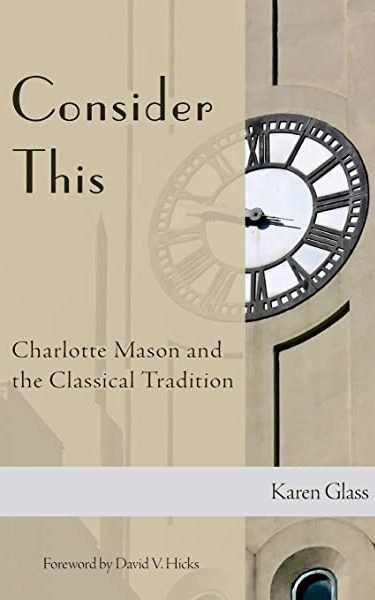
Consider This by Karen Glass, 2014
Wow! I don’t even know where to begin with this book—I wish I had read this years ago! Karen Glass has done a phenomenal job at helping us see the why behind Charlotte Mason’s 20 Principles. She walks us through how Mason based her philosophy of education on principles from classical educators in the past: Augustine, Erasmus, Plato, Comenius, Quintilian, and so on.
Karen Glass also did a wonderful job explaining how classical education morphed after Age of Enlightenment into traditional education (Huxley), as well as neoclassical education (trivium), and how Mason did her best to intentionally bring the ideas of the past into the present. (Charlotte Mason lived from 1842–1923).
There are a lot of books out there that teach parents and educators how to do classical or Charlotte Mason education (e.g. what books to read or how to study art), but few take the time to explain the end goal and purpose behind it all.
Quotes:
“This idea that education is more about *doing* what is right rather than merely *knowing* information, is founded on a long tradition. When our knowledge is transformed into action, it becomes virtue, and virtue was the goal of the classical educators.”

“[W]e can see that the ancient educators understood that learning to love knowledge, love truth, and love beauty was their goal, especially at the outset of educational endeavors—in other words, with young learners.”
“There is time, however, to do so much more than the ‘three R’s,’ which are no more than a utilitarian acquisition of basic skills, and to give every student a rich feast of all the best knowledge the world has to offer: a *liberal* or generous education.”
“It is almost universally agreed that the beginning of classical study is grammar, but grammar meant something very different to the Greeks and Romans, and even the later Renaissance educators, than it does to most teachers today…Quintilian equates *grammar*—a word with Greek origins—to *literature*, a Latin word… When we pause to consider that grammar is equivalent to literature, we see how education was originally begun—by learning to read, and by reading the best books.”
 Lauren Ducommun
Leave a comment